oklyn / New York
Collecting trading cards—whether sports, non-sports, Pokémon, game cards or vintage sets—has grown into a major cultural and business phenomenon in the U.S. To understand that growth, it’s helpful to look not just at the cards themselves (the sets, the print runs, the rarity) but at the brick-and-mortar stores and retail hubs that helped shape the hobby. These stores became gathering places, hubs of innovation, and incubators for what hobbyists call “The Hobby”.
Below are three landmark U.S. card stores (or retailers) whose influence went beyond local trade and sales—they changed how collectors thought about cards, community, and the market. (If you like this style, I can pull 5–10 more for your blog.)
1.Bleecker Trading — New York, NY
4.9•Sports card store•Closed
Why it matters:
Founded in 2020 in Manhattan’s West Village by Mark Zablow, Bleecker Trading quickly became far more than “just another card shop”. According to commentary, the store was built from the start as “a cultural destination” for collectors—retail + community + events. SI+1
Key impacts on the hobby:
- The shop blended traditional card retail (boxes, singles, vintage) with trade-nights, social gathering areas, and works as much as a “collector club” as a store. Sports Collectors Digest+1
- It made the act of going to the card shop an experience, upgrading the hobby’s retail side (and attracting new, younger collectors).
- Its model shows how modern shops can serve both seasoned collectors (vintage, high-end) and newcomers (sealed boxes, TCGs) under one roof.
Why this is good content for your blog:
For CardStoresNearMe.com, Bleecker Trading is a great “modern landmark” – bridging the hobby’s roots and its vibrant present. Highlighting its story shows how even in recent years, card stores are evolving. A tip: If you visit the shop (or interview someone), ask about their trade-night format, how they choose inventory (modern vs vintage), and how they build community.
2.Renata Galasso / Her Hobby Card Business — Bro
Why it matters:
While not exactly a single “iconic store” building with decades of retail foot traffic, Renata Galasso’s business is a landmark in the hobby for several reasons. She began in the early 1970s as one of the few full-time dealers, opened a shop in Brooklyn (later relocating to 10th Avenue) and marketed herself as the “World’s Largest Hobby Card Dealer”. Wikipedia+1
Key impacts on the hobby:
- She was among the pioneers making “set-building” (collecting complete sets) a mainstream offering for collectors, not just pack-buyers. Galasso issued her own “Galasso Glossy Greats” series (1977–84) targeting nostalgic players. Wikipedia
- Her presence helped move card collecting from casual childhood pastime to serious hobby/business: you could buy, build, and trade sets via mail and retail.
- Her business model foreshadowed how card stores (and dealers) would diversify inventory, service serious collectors (sets, vintage) alongside everyday buyers.
Blog suggestion:
Use Galasso’s story to illustrate “the transition era” of hobby stores: In the 1970s–80s, many card shops were becoming more than impulse‐buy counter stands—they were specialized retailers, mail‐order dealers, and community pointers. For your audience, highlight how a collector in India (or anywhere) could trace these roots and see how the hobby matured into what it is now.
3.The Early Era: How Retail & Collecting Converged
Context / Why it matters:
Before we had the sleek shops of today, the foundation of the hobby was built by small retail outlets, hobby shops, card shows and mail-order dealers. As one article notes:
“Very few people made a living buying and selling cards until friends Rick Barudin and Buddy Kurzweil opened Sports Corner inside an antiques mall in Montvale, N.J., marking what is believed to be the first baseball-card shop in the country.” Sports Collectors Digest
Key impacts on the hobby:
- These early shops served as physical meeting places for collectors long before online platforms. They helped define “local card shop (LCS)” culture.
- They helped the hobby establish standards: grading, condition, packaging, trading nights, single card display.
- They linked generations: a kid buying packs in the 1950s could later walk into a shop in the 1970s and sell/trade/upgrade.
Blog suggestion:
Use this section to ground your readers: show how the modern card-store culture didn’t happen overnight. Highlight how store formats evolved: from a cardboard box of packs on a corner shelf to curated shops with events, grading drop-offs, sealed box nights and collector lounge areas. This sets up how stores like Bleecker or Galasso built on that foundation.
Why This Topic Is Relevant for CardStoresNearMe.com
- Local relevance: While your site lists many stores (“near me”), showing the historic role of card stores helps readers appreciate the value of visiting one in person—not just online.
- Storytelling: Many readers may browse for a store but not know the legacy behind the hobby. A blog like this adds depth and encourages engagement.
- SEO & traffic: Title with “Historic U.S. card stores” offers a hook for searches (“history of card shops”, “first baseball card store USA”, etc.).
- Calls to action: At the end you can invite readers to visit their local card store (via your directory), talk to the owner about how the hobby has changed, or share their own “first card shop” memory in comments or social media.
Additional Tips for the Blog
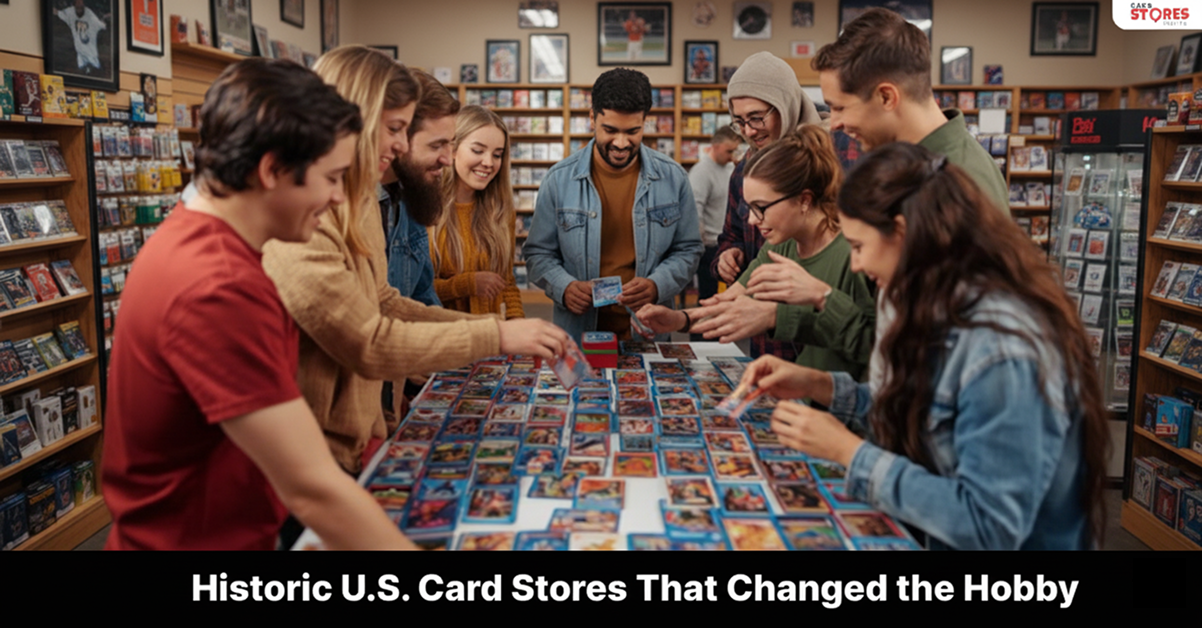
- Include visuals: Use vintage photos of old card shops, storefronts, trade-night scenes, modern shops with events.
- Use sidebar pull-quotes: E.g. “We built a communal space for collectors” (quote from Bleecker shop owner).
- Link to your directory: After discussing each store’s story, link at the end of the blog to your directory of card stores across the U.S. (to help readers find one near them).
- Local angle for international readers: Since your audience might include international readers (like India), you could include a small section on how U.S. card-store culture influences global hobby & how local “stores near you” (including outside the U.S.) can adopt ideas (events, trade nights, community nights).
- Call to reader action: Suggest they drop by their local store, ask the owner “how long have you been in business?”, attend a trade night, bring a friend and start a collecting journey.
